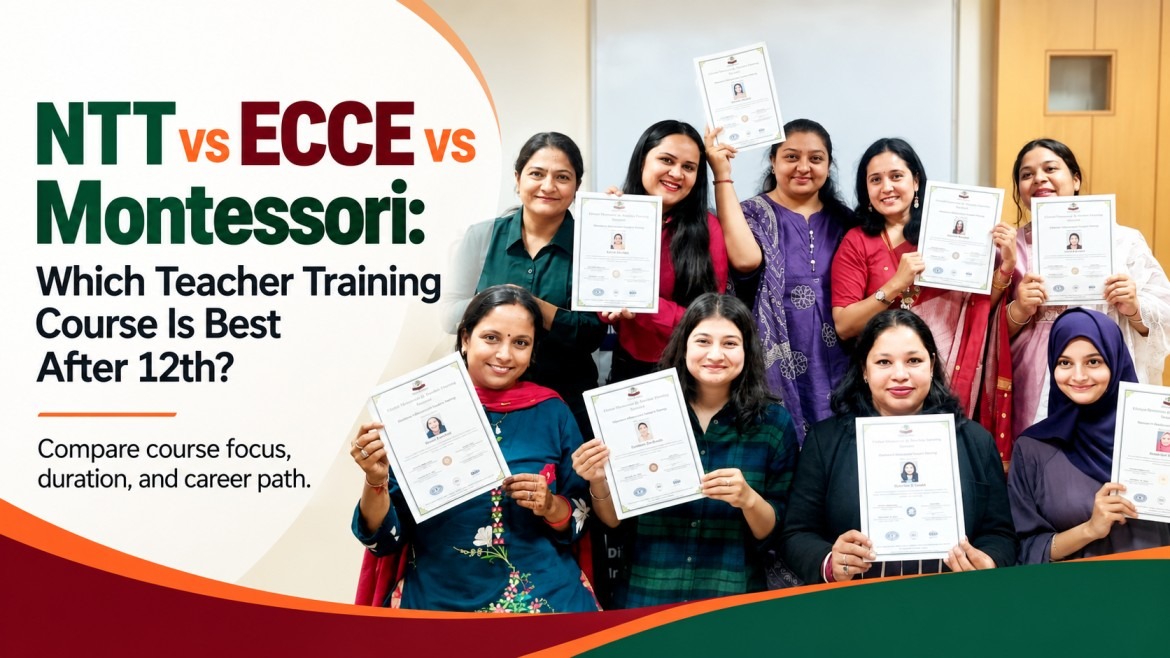
If you have completed Class 12 and want to work with young children, you will probably come across three course names repeatedly: NTT, ECCE and Montessori Teacher Training.
They overlap, but they are not the same.
The simplest way to understand the difference is:
NTT focuses mainly on preparing teachers for nursery and preschool classrooms.
ECCE gives a broader understanding of early childhood care, development and education.
Montessori Teacher Training teaches a specific educational philosophy and classroom method built around Montessori principles and materials.
So which one is best after 12th?
There is no single winner. If you want practical preparation for nursery or preschool teaching, NTT may suit you. If you want broader knowledge of how young children develop, learn and need to be cared for, ECCE may be the better fit. If you specifically want to work in Montessori classrooms and learn Montessori materials and methods, specialised Montessori training makes more sense.
The right choice depends on the type of teacher you want to become.
NTT vs ECCE vs Montessori: Quick Comparison
| Factor | NTT | ECCE | Montessori Teacher Training |
|---|---|---|---|
| Full form | Nursery Teacher Training | Early Childhood Care and Education | Montessori Teacher Training |
| Main focus | Nursery and preschool teaching | Early childhood development, care and education | Montessori philosophy, materials and classroom practice |
| Typical teaching approach | Play, activities, stories, rhymes, basic literacy and numeracy | Holistic development, play-based learning, child psychology, health and early learning | Child-led learning, prepared environment, observation and Montessori materials |
| GMTTI age focus | Mainly ages 2–5 | Mainly birth to 6 years | Mainly ages 2–6 for its Indian-school programme |
| Eligibility for GMTTI Diploma | Class 12 | Class 12 | Class 12 |
| GMTTI Diploma duration | 8–12 months | Current course table lists 6–9 months | 8–12 months |
| Practical component | MCQs, practical assignments and lesson-plan project | MCQs, practical assignments and lesson-plan project | MCQs, practical assignments, lesson-plan project and case study for Diploma/Advanced Diploma |
| Best suited to | Students wanting nursery/preschool classroom preparation | Students wanting a wider early-childhood foundation | Students specifically interested in Montessori education |
| Possible work settings | Nursery, preschool, play school, daycare | Preschool, nursery, kindergarten, daycare and other early-years settings | Montessori schools and Montessori-based early-learning settings |
The eligibility and duration figures above are GMTTI’s own current programme structure, not national rules for every training institute.
What Is NTT?
NTT stands for Nursery Teacher Training.
It is generally designed for people who want to learn how to teach younger children in nurseries, play schools, preschools and similar early-learning settings.
At GMTTI, the NTT curriculum includes child psychology, developmental stages, play-based and activity-based teaching, storytelling, rhymes, early language, numeracy, art and craft, classroom management, lesson planning and parent communication. The programme focuses particularly on teaching children in the nursery and preschool years.
This makes NTT a practical option if your main thought after Class 12 is:
“I want to become a nursery or preschool teacher.”
The course is less about following one particular educational philosophy and more about developing a range of basic early-years classroom skills.
Who may prefer NTT?
NTT may suit you if you:
- want to work mainly with nursery or preschool-aged children
- like activity-based teaching, songs, stories and creative learning
- want practical preparation for running a young learners’ classroom
- are more interested in teaching practice than specialising in one philosophy such as Montessori
At GMTTI, the Diploma in NTT requires Class 10+2 and is listed at 8–12 months. Certificate and Advanced Diploma options are also available.
What Is ECCE?
ECCE stands for Early Childhood Care and Education.
The most important difference is the word care.
ECCE is broader than simply preparing somebody to conduct nursery lessons. It considers a child’s physical, emotional, cognitive, social and language development alongside learning.
India’s National Curriculum Framework for the Foundational Stage defines ECCE broadly as the care and education of children from birth to eight years. It also identifies ages three to eight as the Foundational Stage, covering three years of preschool followed by Classes 1 and 2.
A private ECCE course may focus on a narrower age range. GMTTI’s programme, for example, concentrates primarily on children from birth to six years.
GMTTI’s ECCE syllabus covers areas such as:
child psychology and developmental stages, play-based learning, language and literacy, early numeracy, health and nutrition, creative expression, classroom management, lesson planning and parent-teacher communication.
Who may prefer ECCE?
ECCE may make more sense if you are thinking:
“I want to understand young children properly, not only learn how to teach nursery lessons.”
It can suit students interested in:
- early childhood education
- preschool teaching
- daycare and childcare environments
- child development
- early-years curriculum
- play-based learning
- broader foundational education
For students who are not yet sure whether they want to specialise in Montessori, ECCE can provide a broader early-childhood foundation.
What Is Montessori Teacher Training?
Montessori Teacher Training is different because Montessori is a specific educational method.
The approach originated with Dr Maria Montessori and uses principles such as independent activity, observation, a carefully prepared environment and specialised learning materials.
A Montessori teacher does not simply stand in front of a class and deliver the same lesson to every child.
The teacher observes, prepares the environment, demonstrates materials and guides children towards increasingly independent learning.
At GMTTI, Montessori training includes Montessori philosophy, child psychology, sensorial education, language, mathematics, practical life exercises, classroom environment, lesson planning and the use and presentation of Montessori materials.
Who may prefer Montessori?
Montessori may be the strongest fit if you already know:
“I specifically want to become a Montessori teacher.”
It may suit you if you are interested in:
- Montessori schools
- hands-on learning materials
- child independence
- individualised learning
- observing rather than constantly directing children
- prepared classroom environments
- Montessori practical life and sensorial activities
The key difference is specialisation.
NTT can teach you multiple nursery-teaching techniques. ECCE can teach you broadly about early childhood education. Montessori training goes deeper into one particular educational philosophy and its classroom practice.
Which Course Is Best After 12th?
All three can be relevant after Class 12, depending on the programme and provider.
At GMTTI, Class 12 students can apply for the Diploma level in NTT, ECCE and Montessori Teacher Training.
A useful decision rule is:
Choose NTT if your goal is nursery or preschool teaching
NTT is the more direct option when you want practical training around younger learners and conventional preschool activities.
Your curriculum is likely to include storytelling, rhymes, art, activity-based learning, early literacy, numeracy and classroom management.
Choose ECCE if you want broader early-childhood knowledge
ECCE may be better if you want to understand children’s development and care alongside classroom teaching.
It can make sense for someone interested in preschool education, daycare, curriculum support or the broader early-years field.
Choose Montessori if you specifically want Montessori methodology
If the schools you want to work with follow Montessori principles—or you personally prefer that style of education—specialised Montessori training is the logical choice.
You will spend more time understanding Montessori materials, classroom organisation, observation and child-led learning.
NTT vs ECCE: What Is the Main Difference?
NTT is generally teacher-role focused.
ECCE is child-development and early-education focused.
There is considerable overlap. Both may cover:
- child psychology
- classroom management
- lesson planning
- literacy
- numeracy
- creative activities
- play-based learning
The difference is mainly the breadth and emphasis.
GMTTI describes its NTT course as being designed around nursery and preschool teaching, while its ECCE programme covers development, care and education more broadly for children in the early years.
If you know you want to teach nursery, NTT is easier to understand as a direct pathway.
If you want wider early-childhood knowledge, ECCE deserves serious consideration.
ECCE vs Montessori: Which Is Better?
Again, neither is automatically better.
ECCE looks at early childhood as a whole.
Montessori teaches you how to educate children using Montessori principles.
For example, an ECCE programme may teach you about nutrition, developmental milestones, play-based learning, child wellbeing and communication with parents.
Montessori training may spend much more time on areas such as sensorial materials, practical life activities, the prepared environment, Montessori mathematics and material presentation.
Choose based on the environment in which you want to work.
If you specifically want Montessori classrooms, specialised Montessori training is more relevant.
If you want flexibility across broader early-years environments, ECCE may suit you better.
NTT vs Montessori: Which Is Better for Preschool Teaching?
Both can prepare students for work with young children, but their teaching styles differ.
NTT usually exposes learners to a range of preschool activities such as rhymes, games, stories, crafts and activity-based lessons.
Montessori follows a more defined system.
The child often chooses activities from an organised environment and works with specific materials. The teacher’s role is to observe, demonstrate and guide rather than constantly lead the entire group.
If you enjoy a conventional activity-rich nursery environment, you may prefer NTT.
If you are strongly attracted to Montessori’s child-led philosophy, Montessori training may be more satisfying.
Which Course Has More Practical Training?
Do not judge this from the course name.
Practical training varies between providers.
Before enrolling in NTT, ECCE or Montessori, ask exactly what “practical” means.
At GMTTI, current course information states that NTT and ECCE modules include MCQ assessments and practical assignments, with Diploma candidates completing a lesson-plan project. Montessori modules also include MCQs and practical assignments, while Diploma and Advanced Diploma learners complete a lesson-plan project and case study.
For any institute you compare, ask about:
teaching demonstrations, lesson planning, observations, projects, classroom practice, materials and how practical work is assessed.
A course can be six or twelve months long and still offer weak practical preparation. Duration alone cannot answer that question.
How Long Do NTT, ECCE and Montessori Courses Take?
There is no universal duration across India for every privately offered NTT, ECCE or Montessori course.
At GMTTI, current listed programme durations include:
| Course | Certificate | Diploma | Advanced Diploma |
|---|---|---|---|
| NTT | 3–6 months | 8–12 months | 12–18 months |
| ECCE | 3–6 months | 6–9 months* | 12–18 months |
| Montessori | 3–6 months | 8–12 months | 12–18 months |
*GMTTI’s current ECCE programme table lists the Diploma at 6–9 months. Students should confirm the duration for their specific batch and learning mode before enrolling.
These are GMTTI programme durations.
They should not be presented as national teacher-education rules.
What About Government Recognition and NCTE?
This is one of the most important things to understand before choosing any teacher-training course.
The fact that a private course is called NTT, ECCE or Montessori Teacher Training does not, by itself, establish NCTE recognition.
Under the current NCTE framework, the recognised early-childhood teacher-education programme listed by NCTE is the Diploma in Preschool Education (DPSE). It covers children aged three to six, runs for two academic years and requires the prescribed higher-secondary eligibility. The programme includes theory, practicum and school internship.
This does not mean private NTT, ECCE or Montessori courses have no value.
It means they should not automatically be described as equivalent to an NCTE-recognised DPSE.
If your goal is a particular government recruitment, regulated teaching position or further qualification, read that organisation’s current eligibility requirements before paying for a course.
For private preschool employment, employers may have different requirements.
Which Course Has Better Career Options?
Course title alone does not determine your career.
The exact role available to you can depend on:
- your qualification level
- practical ability
- employer requirements
- experience
- school type
- location
- additional qualifications
Broadly, NTT-trained candidates may look at nursery, preschool, play-school and related early-years roles.
ECCE learners may consider a wider range of early-childhood, preschool, daycare and education-support environments.
Montessori-trained students are particularly suited to schools and centres that actually follow Montessori methods.
A useful approach is to search for the jobs you would like before choosing your course.
Look at five or ten real vacancies in your city.
What qualifications do those employers ask for?
That information is much more useful than choosing a course because somebody says it has “the best scope.”
What About Course Fees?
There is no standard NTT, ECCE or Montessori fee across India.
Fees vary according to:
programme level, duration, learning mode, study materials, practical training, institute and certification structure.
GMTTI’s current course pages state that fees depend on the programme and learning mode and ask students to contact the institute or nearest centre for the current fee structure.
Do not choose purely from the advertised tuition figure.
Ask whether the amount includes:
registration, course material, practical work, examination, certification and any other compulsory charges.
Compare the total amount payable, not only the starting fee.
Online vs Offline: Does It Change Which Course You Should Choose?
Not necessarily.
All three subjects can include theoretical learning online.
But early-years teaching also involves practical skills.
For NTT, that may mean activity planning, storytelling or teaching demonstrations.
For ECCE, it may include observation, developmental activities and lesson planning.
For Montessori, seeing how materials are handled and presented can be particularly important.
GMTTI currently offers online or distance options alongside regular or hybrid study across its NTT, ECCE and Montessori programmes.
If you need online study, ask:
How are practical skills taught online?
That is more important than simply asking whether the course is available online.
How to Choose Between NTT, ECCE and Montessori
Before enrolling, answer these five questions.
1. What age group do I want to work with?
If you mainly picture yourself in a nursery or play-school classroom, NTT may suit you.
If your interest is wider early-childhood development, look closely at ECCE.
If your goal is Montessori education, choose specialised Montessori training.
2. What type of school do I want to work in?
Look at actual employers.
Montessori schools may prefer Montessori-specific preparation. General preschools may advertise NTT, ECCE, pre-primary or other early-years qualifications.
3. Do I want broad training or a specialised method?
ECCE is broader.
Montessori is more specialised.
NTT sits closer to practical nursery and preschool teacher preparation.
4. What qualification does my target employer require?
Do not assume that every certificate will be accepted everywhere.
Check the vacancy, school or recruitment authority directly.
5. What exactly will I learn?
Compare syllabi.
A course name tells you far less than the actual modules, assignments, practical work and assessments.
Frequently Asked Questions
Which course is best after 12th: NTT, ECCE or Montessori?
It depends on your goal. Choose NTT for nursery/preschool-focused teacher preparation, ECCE for broader early-childhood education, and Montessori if you specifically want to learn Montessori methods and work in Montessori environments.
Can I do NTT after 12th?
Yes. GMTTI currently accepts Class 12 students for its Diploma in NTT. Other institutions may have different eligibility rules.
Can I do ECCE after 12th?
Yes. GMTTI’s Diploma in ECCE accepts students who have completed Class 10+2.
Can I do Montessori Teacher Training after 12th?
Yes. GMTTI currently lists Class 10+2 as the eligibility for its Diploma in Montessori Teacher Training.
Is ECCE the same as NTT?
No. They overlap, but ECCE is broader and covers early childhood care, development and education. NTT is generally more directly focused on nursery and preschool teaching.
Is Montessori the same as ECCE?
No. Montessori is a specific educational philosophy and teaching method. ECCE is the broader field of early childhood care and education.
Which is better for becoming a preschool teacher?
Both NTT and ECCE can be relevant depending on the employer and programme. If you want Montessori schools specifically, Montessori training may be more relevant.
Which course is recognised by NCTE?
NCTE currently lists the Diploma in Preschool Education (DPSE) as its recognised early-childhood teacher-education programme. A privately offered course being called NTT, ECCE or Montessori does not by itself mean it is an NCTE-recognised DPSE.
Can these courses be studied online?
Yes, many providers offer online options. GMTTI currently offers online/distance or hybrid options across its NTT, ECCE and Montessori programmes. Students should still ask how practical training and assessment work in the online format.
There Is No Single “Best” Course
NTT, ECCE and Montessori Teacher Training are three different ways of preparing for work with young children.
Choose NTT if your priority is practical nursery and preschool teacher preparation.
Choose ECCE if you want a broader understanding of children’s early development, care and education.
Choose Montessori Teacher Training if you specifically want to understand and use Montessori philosophy, materials and classroom methods.
After Class 12, the smartest decision is not to ask which certificate sounds strongest.
Ask:
Which programme teaches the skills I need for the type of educator I want to become?
Then compare the curriculum, practical training, qualification, duration, fees, learning mode and the requirements of the schools or organisations where you hope to work.
That will give you a much better answer than choosing NTT, ECCE or Montessori based on the course name alone.