
If you want to work with young children in a nursery, preschool or pre-primary classroom, Nursery Teacher Training (NTT) is one of the courses you are likely to come across.
But choosing an NTT course in India is not simply a matter of finding the shortest programme or the nearest institute.
Different institutes use terms such as NTT, preschool teacher training, Montessori teacher training and ECCE. Course eligibility, duration, practical training, certification and study modes can differ significantly. More importantly, an NTT qualification should not automatically be treated as equivalent to every formal teacher-education qualification required for school or government teaching positions.
India’s National Education Policy 2020 has formally recognised early childhood education as a national priority — strengthening the demand for trained nursery and pre-primary educators and increasing employer preference for formally certified teachers. The policy’s emphasis on Foundational Literacy and Numeracy means that schools and preschools across India are actively professionalising their early years hiring, making credible NTT certification more valuable in 2026 than at any point in the past decade.
This guide explains what NTT is, who it is suitable for, what students should expect to learn, how long courses take, what affects the fees, how online and classroom training differ, how NTT compares with Montessori, ECCE and other teacher-education pathways, and how to choose the right institute.
What Is Nursery Teacher Training?
Nursery Teacher Training, or NTT, is a teacher-training pathway focused on preparing educators to work with young children in nursery, preschool and pre-primary learning environments.
Young children learn differently from older school students. A nursery teacher needs to help children develop language and communication, early literacy, early numeracy, social skills, emotional awareness, fine and gross motor skills, independence, classroom routines, creativity, and curiosity.
For this reason, nursery teacher preparation should go beyond textbooks and worksheets. A useful NTT programme should help future teachers understand child development, play-based learning, storytelling, classroom management, lesson planning, activity design, child observation and communication with parents.
Is NTT the Right Course for You?
Before asking which NTT institute is best, ask yourself three questions.
1. Which age group do I want to teach? NTT is primarily associated with young children in nursery, preschool and pre-primary settings. If you want to teach older children, another teacher-education pathway may be more appropriate.
2. Do I want general nursery training or a specific teaching methodology? If you specifically want to work in a Montessori classroom, Montessori Teacher Training may be more suitable because Montessori is a distinct educational approach with its own philosophy, materials and classroom structure. If you want broader preparation in child development, care and early-years education, an ECCE programme may deserve comparison.
3. What qualifications do my target employers require? This is particularly important. Do not assume that an NTT certificate automatically qualifies you for every teaching job. Check actual job advertisements, school requirements and government recruitment rules before choosing a programme.
NTT Course Eligibility in India
There is no single eligibility requirement used by every NTT provider in India. Requirements vary according to institute, programme level, course duration and delivery format.
Some institutes provide entry-level programmes after Class 10, while many diploma-level programmes are designed for candidates who have completed Class 12. Advanced programmes may require graduation.
For example, GMTTI currently structures its NTT programmes as follows:
| Programme | Entry Requirement | Approximate Duration |
|---|---|---|
| Certificate in NTT | Class 10 | 3–6 months |
| Diploma in NTT | 10+2 | 8–12 months |
| Advanced Diploma in NTT | Graduation | 12–18 months |
Important: Eligibility for admission and eligibility for employment are not the same thing. A candidate may be eligible to join a course after Class 12 while a particular school may still prefer graduates or candidates with additional qualifications. Always check both.
Can You Do an NTT Course After 12th?
Yes. Class 12 is a common entry point for nursery and early-childhood teacher-training programmes in India.
Before enrolling after Class 12, consider whether you want to work specifically in preschool or prefer Montessori education, whether you plan to continue graduation later, whether the schools you want to work for require graduation, and whether the programme includes practical training. Thinking about the eventual job is more useful than simply choosing the fastest available course.
Can You Do NTT After Class 10?
Some institutes offer entry-level NTT certificate programmes after Class 10. This may provide an introduction to early-years education, but employment requirements can be higher than course-entry requirements. If your long-term goal is a professional teaching career, completing Class 12 alongside specialised teacher training is advisable.
NTT Course Duration
NTT course duration varies considerably in India.
| Programme Level | Typical Duration | Best Suited For |
|---|---|---|
| Short Certificate | 3–6 months | Introduction to early-years teaching, career explorers |
| Diploma | 6–12 months | Career-ready preparation for nursery and preschool roles |
| Advanced Diploma | 12–18 months | Comprehensive preparation for senior roles, entrepreneurship |
Do not assume that a longer course is automatically better. Similarly, a very short programme should not automatically be rejected.
Instead, compare total learning hours, depth of curriculum, practical assignments, trainer interaction, classroom practice, assessments, projects and feedback. A twelve-month course with very little interaction may offer less practical development than a carefully structured shorter course with extensive demonstrations, assignments and trainer feedback.
What Is Taught in an NTT Course?
Syllabi differ between institutes, but strong nursery teacher preparation usually covers several core areas.
Child Development and Psychology. Teachers need to understand how children develop physically, emotionally, socially, cognitively and linguistically. This knowledge helps teachers set realistic expectations — a three-year-old cannot reasonably be expected to learn, sit or communicate in the same way as a seven-year-old.
Early Language Development. This includes speaking and listening, vocabulary building, storytelling, rhymes, conversation, early literacy, sound awareness and phonics. A good teacher creates situations where children hear, understand and use language meaningfully rather than simply memorising letters.
Early Numeracy. Young children begin mathematics through concrete experiences — counting, matching, sorting, patterns, shapes, quantities, comparison, sequencing and simple problem-solving. A strong NTT programme should show teachers how to make mathematical concepts understandable rather than relying only on worksheets.
Storytelling. An important nursery-teaching skill that supports vocabulary, listening, imagination, comprehension, sequencing, emotional development and participation. Teacher training should help learners understand voice, expression, questioning, props and ways to involve children in a story.
Art, Craft and Creative Activities. Activities that help children develop fine-motor control, hand-eye coordination, creativity, concentration, sensory awareness and confidence. Future teachers should learn how to select activities that match children’s developmental levels rather than producing attractive displays.
Classroom Management. Managing a nursery classroom does not mean forcing young children to remain silent. Teachers need strategies for routines, transitions, sharing, attention, movement, group activities, conflict, classroom rules and positive behaviour — creating an environment where children can learn safely and independently.
Lesson Planning. A useful nursery lesson plan considers the learning objective, age group, activity, required materials, estimated time, teacher instructions, child participation and assessment method. Teacher training should help students design their own plans rather than simply copy ready-made examples.
Child Observation and Assessment. Young children should not be assessed only through formal tests. Teachers learn to observe language, participation, social interaction, motor development, understanding, independence, interests and difficulties — and to use these observations to plan more suitable activities.
Parent Communication. Preschool teachers communicate directly with families about progress, behaviour, participation, routines, strengths and areas needing support. Teacher training should therefore include professional and respectful communication skills.
Health, Hygiene and Safety Awareness. Young children depend heavily on adults for a safe learning environment. Nursery educators should have appropriate awareness of hygiene, healthy routines, wellbeing and child safety.
Practical Training: One of the Most Important Things to Check
A teacher-training course should not consist only of notes, videos and multiple-choice questions. Teaching is a practical skill.
Before joining any NTT institute, ask exactly what “practical training” means in their programme. Useful practical components include lesson-plan preparation, storytelling demonstrations, activity planning, phonics activities, teaching-aid preparation, classroom observation, mock teaching, child-observation records, project work, trainer feedback and supervised classroom exposure.
GMTTI’s NTT programme, for example, integrates material handling sessions, lesson simulation exercises, activity planning assignments and portfolio development throughout the course — not as an add-on at the end. This practical formation runs across all delivery formats, including online and hybrid programmes, ensuring that graduates are classroom-ready from the day they complete the course.
The more clearly an institute can explain its practical process, the easier it becomes to judge the quality of the programme.
NTT Course Fees in India
There is no standard NTT course fee across India. Fees differ according to institute, programme level, duration, delivery format, trainer support, practical sessions, study material, assessment and certification.
Instead of looking only at the advertised price, ask for the complete fee structure in writing. Confirm whether the quoted fee includes admission charges, study materials, examinations, practical sessions, certification, project evaluation, online access, certificate delivery and any resubmission charges.
A cheaper programme is not necessarily better value if important components are charged separately. Similarly, a more expensive programme should be able to explain what additional teaching, practice or support students receive.
GMTTI’s NTT programmes are priced competitively within the Indian teacher training market, with flexible EMI and instalment options available across programme levels. Contact the GMTTI counselling team for the current fee schedule applicable to your chosen programme and delivery format.
Online NTT Course vs Classroom NTT Course
Both formats can work when they are designed well. The right choice depends on your circumstances and learning style.
Classroom NTT Training may suit you if you want direct trainer interaction, live demonstrations, structured schedules, peer interaction, immediate feedback and hands-on practice. It may be particularly useful for learners entering education for the first time.
Online NTT Training may suit working professionals, parents, students living away from a training centre, and candidates who need schedule flexibility. Before enrolling online, ask whether classes are live or recorded, whether you can interact with a trainer, how assignments are checked, whether practical demonstrations are included, and what academic support is available.
“Online” should describe the delivery format, not the absence of practical learning.
Hybrid Training combines online or independent study with selected direct interaction. This can be useful when theoretical topics are easier to study flexibly while demonstrations and practical work benefit from face-to-face sessions.
GMTTI offers all three formats — classroom, online and hybrid — across its NTT programmes, with identical IAO-accredited certification regardless of the study mode chosen. The certificate does not specify whether you studied online or in a classroom.
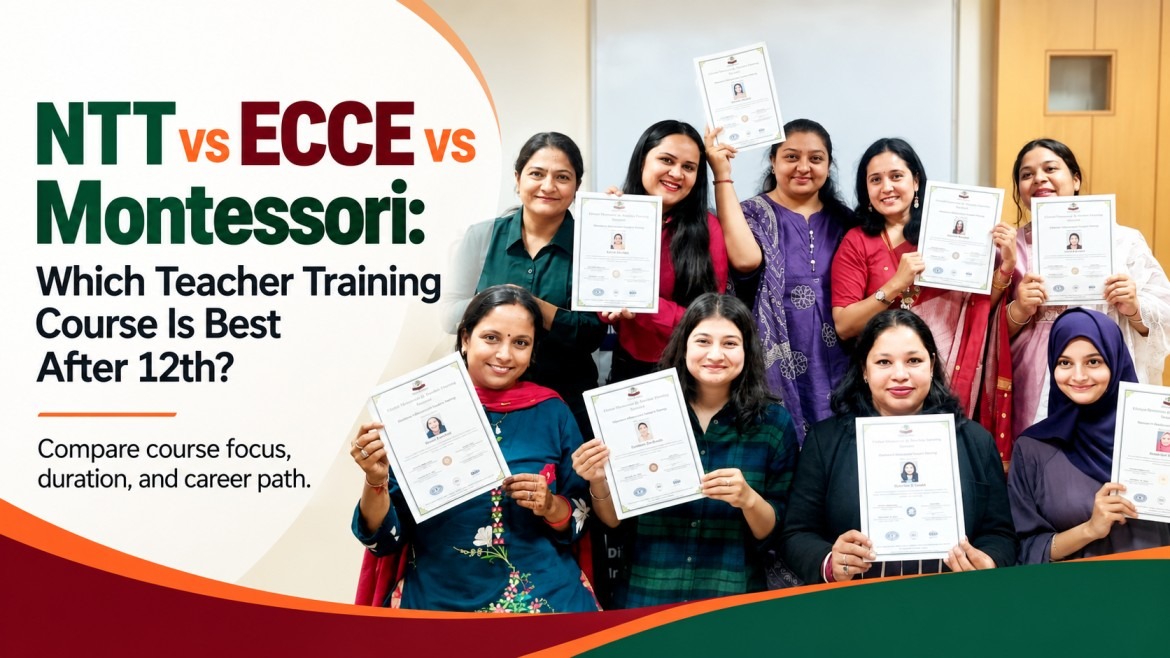
NTT vs Montessori vs ECCE
Students often encounter all three terms while researching preschool teacher training. They are related but not identical.
| Course | Main Focus | Best Suited For |
|---|---|---|
| NTT | Nursery and pre-primary classroom teaching | Candidates seeking nursery and preschool teaching preparation |
| Montessori Teacher Training | Montessori philosophy, environment, materials and methodology | Candidates specifically interested in Montessori education |
| ECCE | Broader early-childhood development, care and education | Candidates seeking wider understanding of the early-childhood field |
If you know that you want to work in a Montessori environment, specialised Montessori Teacher Training may be more suitable. If you want broader preparation in early childhood development and care, ECCE may be the better fit. NTT is most directly focused on nursery and pre-primary classroom preparation.
Neither course is universally better. Choose according to the environment and role you want.
NTT vs D.El.Ed: An Important Difference
This distinction is particularly important for students in India.
NTT offered by a private training institute should not automatically be treated as equivalent to D.El.Ed (Diploma in Elementary Education) or another formal teacher-education qualification required for regulated teaching positions.
Before enrolling, determine whether your goal is private preschool teaching, nursery teaching, Montessori teaching, formal elementary-school teaching, government recruitment or another regulated educational role.
If a government recruitment notification or school requires a specific qualification, follow that requirement. Do not assume that a private certificate replaces it.
Is an NTT Course Recognised?
This question needs to be more specific.
Instead of asking “Is this NTT course recognised?”, ask: “Recognised by whom, for what purpose, and accepted by which employers?”
An institute may have private accreditation, institutional membership, quality certification or an independent certificate-awarding arrangement. These are not automatically the same as statutory teacher-education recognition.
Before joining any programme, ask who issues the final certificate, what accreditation the institute holds, whether that accreditation can be independently verified, and whether the employers you are targeting accept the qualification.
GMTTI’s NTT programmes carry accreditation from the International Accreditation Organisation (IAO), USA — an externally issued, independently verifiable international accreditation that gives the certificate genuine standing with educational employers across India and internationally. This is a meaningful differentiator from institutes operating with domestic registrations or self-declared affiliations, and it is particularly relevant for NTT graduates who may later seek teaching opportunities in Gulf countries, Southeast Asia or international schools within India, where credential verification is standard practice.
Career Options and Salary Expectations After NTT
Depending on the employer’s requirements and your wider education, NTT may support applications for roles in several types of environments:
| Role | Typical Setting | Qualification Expectation |
|---|---|---|
| Nursery Teacher | Nursery schools, playgroups | NTT certificate or diploma, 10+2 or graduation |
| Preschool Educator | Standalone preschools, franchise chains | NTT or ECCE, 10+2 minimum |
| Pre-Primary Teacher | Pre-primary sections of formal schools | NTT or Montessori, graduation often preferred |
| Daycare Educator | Corporate or community childcare centres | NTT or ECCE, 10+2 minimum |
| Activity Centre Facilitator | Children’s learning and activity centres | NTT or related qualification |
Experienced early-years educators may later develop towards responsibilities involving curriculum support, activity planning, teacher mentoring, coordination or centre supervision.
Salary expectations. There is no single salary figure that applies to every nursery teacher in India, and any institute that promises a specific income should be viewed with caution. However, realistic market ranges can help you plan.
Starting salaries for NTT-certified teachers in Indian preschools typically range from twelve thousand to twenty thousand rupees per month in Tier 2 and Tier 3 cities, and from eighteen thousand to thirty thousand rupees per month in metro cities, depending on the school type, qualifications and experience. Senior educators, coordinators and teachers at established preschool chains or international schools can earn significantly more. Pay also varies according to full-time or part-time employment, English proficiency, additional certifications and job responsibilities.
Rather than choosing an NTT course because of an advertised salary promise, research current vacancies in your own city to build a realistic picture of local opportunities.
How to Choose the Best NTT Course in India
There is no single “best NTT course” for every student. Use this checklist instead.
Check the curriculum. Do not enrol based only on the name of the qualification. Request the full syllabus.
Check practical training. Ask what you will actually create, demonstrate or practise. An institute that cannot explain its practical process clearly is a warning sign.
Check trainer credentials. Find out who teaches the programme and what relevant classroom experience they have.
Check assessment. Ask how your learning is evaluated — assignments, projects, demonstrations and feedback are more meaningful than multiple-choice tests alone.
Check certification and accreditation. Understand exactly who awards the certificate and what the accreditation means. Can it be independently verified? Is it accepted by the employers you are targeting? GMTTI’s IAO (USA) accreditation, for example, is externally issued and independently verifiable — a standard that not all training institutes meet.
Check the full fees. Get the complete cost in writing, including all examination, certification, material and practical session charges.
Check the study format. For online courses, understand how practical skills and trainer interaction are handled. GMTTI’s online NTT programme includes material demonstrations, lesson simulation, assignment feedback and academic support throughout — not just recorded lectures.
Check employer expectations. Research actual schools and preschools before choosing your qualification.
Check support. Find out whether trainers are available when you need help during the programme.
Red Flags to Watch for Before Joining an NTT Institute
Be cautious if an institute guarantees a job without explaining the conditions, promises an unrealistic salary, says a private certificate is accepted everywhere, cannot explain who awards its certificate, refuses to show the syllabus, cannot describe its practical training, uses unclear accreditation claims, creates artificial admission urgency, provides no verifiable contact information, or focuses only on the certificate rather than what you will learn.
Teacher training should prepare you for working responsibly with children. The quality of the learning matters.
Frequently Asked Questions About NTT Courses in India
What is the full form of NTT? NTT stands for Nursery Teacher Training. It is a teacher-training programme focused on developing skills for teaching young children in nursery, preschool and pre-primary environments.
Can I do NTT after Class 12? Yes. Many NTT diploma programmes accept candidates who have completed 10+2. Eligibility differs between institutes, and some employers may additionally prefer graduation.
Can I do NTT after Class 10? Some institutes provide certificate-level programmes after Class 10. Check both the admission eligibility and the education requirements of employers you intend to approach.
Can I study NTT online? Yes. Online NTT programmes are available from institutes like GMTTI. Before joining, check how trainer interaction, practical demonstrations, assignments and assessments are handled. The online certificate should carry the same accreditation as the classroom certificate.
Which is better: NTT or Montessori? Neither is automatically better. NTT focuses on nursery and pre-primary teaching preparation, while Montessori training specialises in Montessori philosophy and methodology. Choose based on the type of school you want to work in.
Which is better: NTT or ECCE? The choice depends on your goal. NTT is more directly focused on nursery classroom preparation, while ECCE covers broader early-childhood development, care and education.
Is NTT equivalent to D.El.Ed? Do not assume so. These are different educational pathways. Always check the qualification required for the particular school or government teaching post you want.
Is NTT valid for government jobs? Government recruitment requirements vary according to the post and authority. Always check the latest official recruitment notification rather than assuming that a private NTT qualification is sufficient.
What are the NTT course fees in India? There is no single standard fee. Costs vary according to institute, programme duration, course level, study mode and included services. Request the complete current fee structure before enrolling. Contact GMTTI for current fee details.
How do I know if an institute’s NTT certificate will be accepted by schools? Check whether the institute holds external accreditation from a recognised body — not a self-declared membership. Ask the institute to name specific schools where their graduates are employed. GMTTI’s IAO (USA) accreditation is externally issued and independently verifiable by any employer.
Start Your NTT Journey with the Right Institute
Choosing a Nursery Teacher Training course in India in 2026 should begin with your career goal — not with an advertisement. First decide whether you want to work in nursery or preschool education. Then compare NTT with Montessori, ECCE and any formal teacher-education qualification relevant to your intended job. Once you know the right pathway, evaluate institutes on the things that actually matter: curriculum, practical learning, trainer expertise, transparent certification, realistic career guidance and clear fees.
A good NTT programme should leave you with more than a certificate. It should help you understand young children and give you practical tools to teach them well.
If you have decided that nursery teaching is the direction you want to pursue, GMTTI’s Nursery Teacher Training programme offers Certificate, Diploma and Advanced Diploma pathways with IAO (USA) accreditation, practical training integrated throughout, and flexible online, hybrid and classroom delivery formats across 55+ centres in India.
Speak with a GMTTI course counsellor to confirm the programme level, fees, next batch schedule and study format that fits your situation.
Call or WhatsApp: +91 8160359574 Email: info@globalmontessori.co.in Website: globalmontessori.co.in
Batch sizes are limited. Enquire today to secure your place in the next intake.